
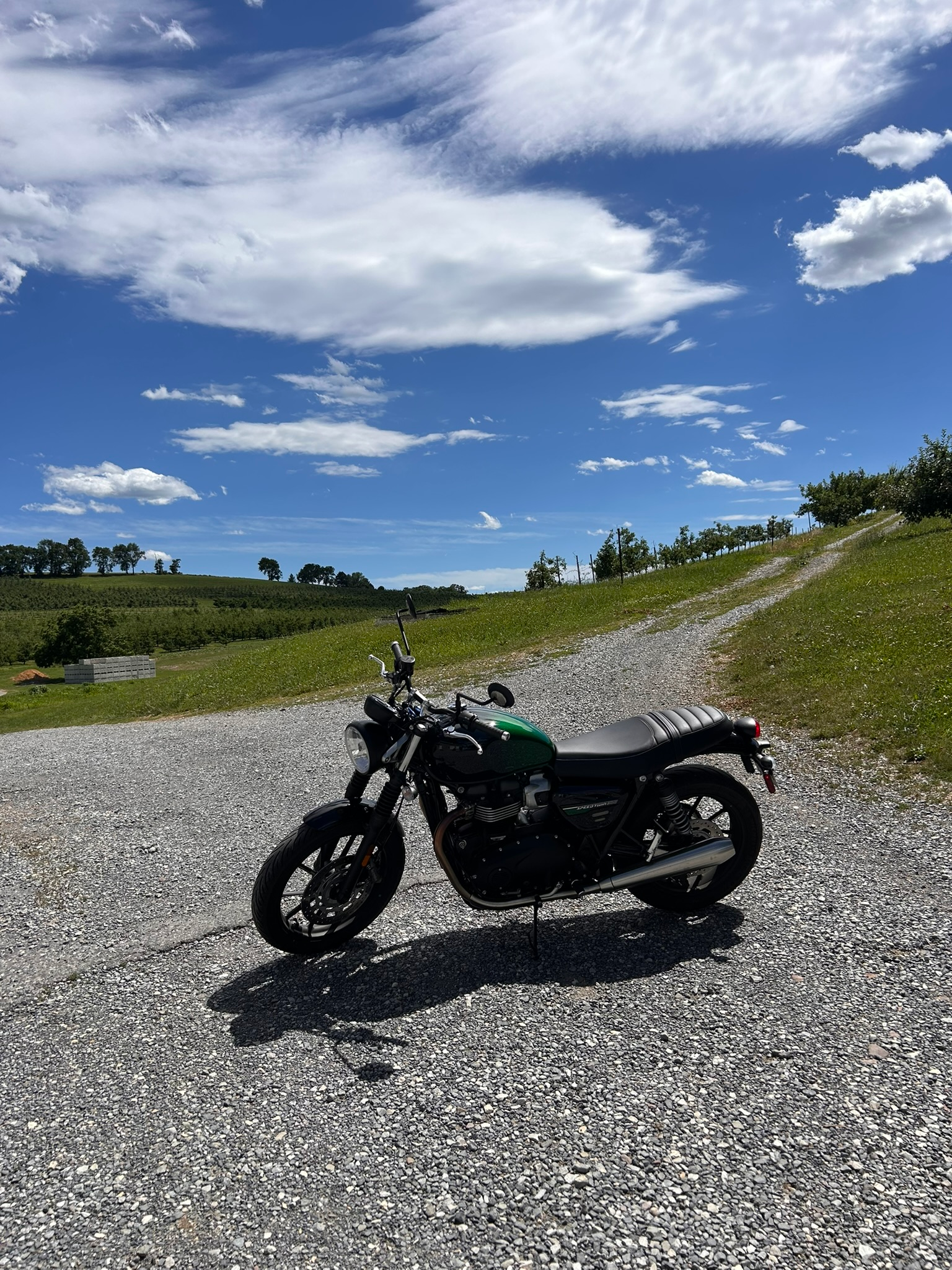
Part 1 of the “From Car to Motorcycle Transition” Series
If you’ve spent years behind the wheel of a car like I have, from a car to a motorcycle transition isn’t just about learning new controls; it’s about rewiring how you think. The motorcycle vs car driving differences go far deeper than the controls themselves, touching everything from how you brake to how you scan the road.
I recently had the pleasure of meeting Kayla Yaakov (IG: @kayla_yaakov), an 18-year-old professional motorcycle racer who put it perfectly: “A motorcycle is a machine and you need to tell it what to do.”
You should either be giving it throttle or you should be on the brake. The moment you are coasting (with the clutch pulled in and no power to the rear wheel), that’s when things go sideways. Maybe even literally.

In a car, coasting is no big deal. It can even be fun! On a motorcycle though, it’s how accidents happen.
That one insight reframes everything. So let’s dig into exactly what changes when you trade four wheels for two.
Learning the Controls: Same Parts, Different Places
If you already know how to drive a manual transmission car, the good news is that you already know the cast of characters: clutch, gear shift, brake, and throttle (gas). The difference is where they live.
On a motorcycle:
- Clutch: moves from your left foot to your left handlebar (a lever you pull)
- Gear shift: moves from your right hand to your left foot
- Rear brake: stays at your right foot
- Front brake: your right handlebar as a lever (I haven’t driven every type of car out there, but I usually only have one brake pedal)
- Throttle: moves from your right foot to your right handlebar (twist your knuckles toward you to accelerate)

One of the more surprising parts of the car to motorcycle transition is that the controls aren’t new, just relocated. Your hands and feet are engaged at all times. It can feel like a lot at first, because it is, but eventually it becomes second nature, and your mental energy can shift toward the bigger picture: reading the road.
In an Emergency, Forget What the Car Taught You
In a car, the emergency instinct is simple: brake. Modern vehicles even have collision alerts to reinforce it. Deer in the road? Brake. Someone stopped ahead? Brake. “Watch out for that…(insert noun here)!” Brake.
On a motorcycle, that instinct can get you into serious trouble.
Slamming the front brake too hard locks the tire and can send you over the handlebars. Pulling the clutch without immediately re-engaging a gear removes power from the rear wheel and causes fishtailing. Neither is a good outcome for your reaction.
So what do you do instead? You evade.
In the MSF course (Motorcycle Safety Foundation), riders practice identifying escape routes before they’re needed. And it isn’t always the lane you are in. Road shoulders, driveways, or the opposing lane (when it’s clear) can all be good. You’re not waiting for an emergency to think about your options; you’re already scanning for them.
Slow Down Before the Stop Sign, Not At It
Car drivers, myself included, tend to trust their brakes a little too much. Flying up to a stop sign and stopping hard is a bad habit in a car; on a motorcycle, it’s dangerous (I learned this the hard way).
Instead, the goal is to downshift gradually, using engine braking to slow down earlier and more smoothly. You can slow significantly without ever touching the brake lever but with a word of caution: cars behind you won’t see your brake lights when you engine-brake, so don’t assume they know you’re slowing down.
Smooth, early, deliberate, that’s the rhythm you are looking for.
A note to car drivers, it is very scary for a motorcyclist to see a car flying up to a stop sign either behind them or on a side at an intersection. Don’t give a motorcyclist a reason to be spooked into evading if they don’t have to.
Always Be Looking: The Z Pattern

In a car, I scan the road without much conscious thought following a pattern of a few seconds ahead, a glance at the mirrors (left, rear, right), repeat. It works fine and I am mostly on autopilot.
On a motorcycle, looking ahead becomes a deliberate skill. The MSF course teaches the Z-formation scan: sweep your eyes far left, move right across the horizon, then zig-zag down to the near view on your left, sweep right again, check your mirrors, and repeat.
You’re looking “12-seconds ahead” for:
- Road curves and elevation changes
- Hidden driveways on a bend
- Stop signs and signals ahead
- Wildlife
- “Cagers” (those in four-wheel model vehicles)
- Road surface hazards such as gravel, potholes, debris, and even the less obvious like bumps
What you are looking for doesn’t really sound all that different than when you are looking ahead in a car. The pattern is different, but you also pay attention more to things that you would not care about in a car or truck. Your balance can be impacted by slight variations in a road and you will need to adjust your speed, your position in the lane, or more to be able to accommodate it.
What’s interesting is that commuting on my motorcycle has actually changed how I scan in my car too. I’ve added the Z pattern to my “look ahead for a few seconds” before moving on to my mirror pattern. I believe the Z pattern makes you a more aware driver across the board.
Look Where You Want to Go (And Mean It)
Every instructor will tell you: turn your head in the direction you want to go, and your body and handlebars will follow. If you look left, you will be able to turn left. If you look right, you will be able to turn right. If you look down, your motorcycle will go down, so always look out ahead while you are riding.
Here’s the problem though. After 30+ years of driving a car, I had trained myself out of that instinct. Car drivers can look sideways while keeping their arms and the wheel straight. I know I can drive straight while looking around. I have been stuck in traffic more times than I can count while looky-loos have their heads turned to watch rescue workers while going straight ahead. So, that habit doesn’t translate.
Re-learning to lead with your eyes on a motorcycle takes deliberate, repetitive practice. But once it clicks, it becomes one of the most natural parts of riding.
Curves: Carry Speed In, Not Brake Through
If you love twisty roads, motorcycles will change your relationship with them. In a car, it’s common to brake into a curve and accelerate out. On a motorcycle, that approach creates problems.
The rule: slow down, select the right gear, and set your entry position before you reach the curve, not during it.

Once you’re in the curve, you want to maintain or gently add throttle all the way through. That throttle keeps the bike stable and helps it naturally straighten out of the lean as you exit. If you brake mid-curve or come off the throttle abruptly, you’ve introduced instability at exactly the wrong moment.
Gear Selection: Stop Rushing to 5th
My old manual car habit is to get to the highest gear as fast as possible and cruise. At 40–45 mph, I’d be in 5th and stay there.
On a motorcycle, that logic doesn’t apply. At 40–45 mph, I’m comfortably riding in 3rd gear. I’m not chasing high gears since I’m using whatever gear fits my speed and situation (though I have also been known to look at the tachometer display just to check how many RPMs I’m running in the gears). It’s made me think more deliberately about gear selection than I ever did in a car.
(Note: gear-to-speed ratios vary by make and model of motorcycle, so check your specifics before deciding which gear you should ride. You can check out Cycle World or your bike’s manufacturer’s website.)
The Friction Zone: Your Secret Weapon for Slow-Speed Control
Perhaps the biggest clutch-related difference between cars and motorcycles is the Friction Zone which is that sweet spot where the clutch is partially engaged and the bike is on the edge of moving under its own power.
In a car, you barely spend time there. On a motorcycle, the Friction Zone is a place you can live, especially at low speeds. Parking, navigating tight turns, stop-and-go traffic, balancing at a red light on a hill, all of it is managed in the Friction Zone.
Mastering it takes time, but once you do, you’ll have dramatically better control of your motorcycle at slow speeds. And stop-and-go traffic, frustrating as it is, turns out to be some of the best practice you can get.
Up Next in This Series

This post covers the foundational mindset shift from car to motorcycle. In future installments, we’ll go deeper on the skills that matter most:
- Part 2: Mastering the Friction Zone: Drills and Practice Tips for Slow-Speed Control
- Part 3: Emergency Braking and Evasion: How to Train Your Brain to Respond Safely
- Part 4: Scanning the Road Like a Rider: Building the Z Pattern Into Muscle Memory
- Part 5: Looking Through Curves: Entry Speed, Lean Angle, and Throttle Control Explained
Read also: Mastering Motorcycle Commuting: Tips for New Riders
New to motorcycles? Already riding? Drop your questions or biggest “aha” moments in the comments. I’d love to hear what shifted for you.