
Part 3 of the Car-to-Motorcycle Transition series
I remember the day in early August 2025 when I finally felt I had enough skill to ride my motorcycle from my house to the local high school parking lot to keep practicing. Riding along the street at about 30mph, I came upon a woman walking her dog on the other side of the street. She was on her phone, and her dog was on a long leash.
You know those moments in life when everything seems to happen in slow motion? Yeah, this was like that. I could see the dog getting excited about the motorcyclist coming down the street. I watched him pull against the leash and lift his front two legs like he was getting ready to pounce. And I watched him dart across the street, figuring out that the thing he was ready to pounce on was me.
And what did I do? I hit the brakes and slowed down. Because in a car, that’s what I was trained to do.
If you read Part 1 of this series, you already know the car-to-motorcycle transition rewires far more than just how you brake. But emergency braking is where that rewiring gets tested first, and hardest.
The Car Instinct and Why It’s Dangerous on a Motorcycle
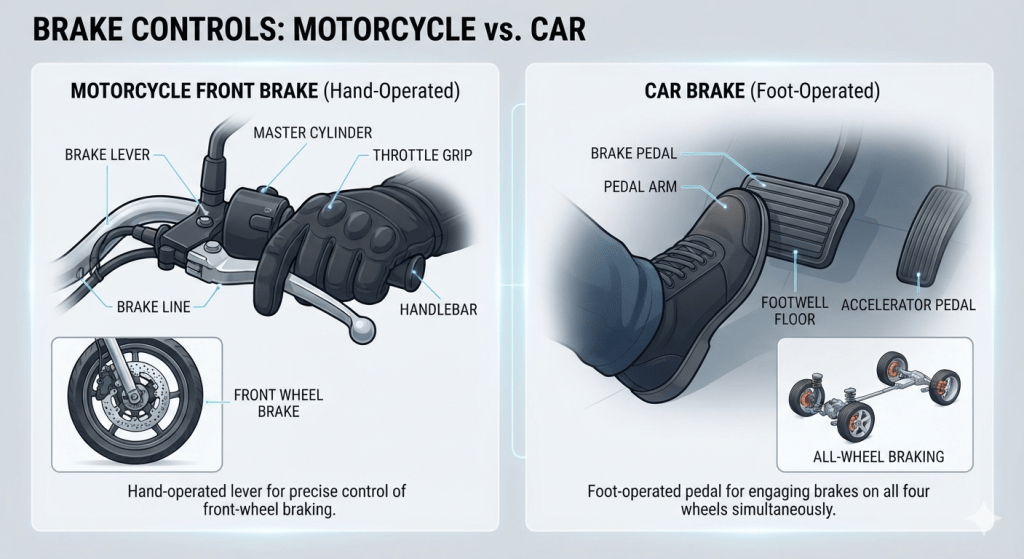
Every one of us who came to motorcycling from years behind the wheel of a car is carrying the same hidden liability: thousands of hours of muscle memory that says danger equals brake. In a car, that instinct is correct. Four wheels, a stable chassis, and a couple tons of metal around you mean that squeezing the brake pedal harder is almost always the right move. Your car isn’t going to fall over.
A motorcycle is a different physics problem entirely. You’re balanced on two contact patches the size of your palm, and staying upright depends on managing traction, weight transfer, and lean angle, in addition to stopping distance. Grab the brake the way you’d stomp a car pedal, and you can lock the front wheel, lose the stability keeping you upright, and go down before you’ve even processed what startled you. The dog darting across the street wasn’t the dangerous part. My car-trained hands responding to it the way they always had was.
Why This Takes Reprogramming, Not Just Reading
Here’s the uncomfortable truth: you can read this entire article, nod along, and still grab a fistful of front brake in a real emergency because knowledge and reflex live in different parts of the brain. Reflexes are built through repetition, not comprehension. That’s exactly why your car-braking instinct is so strong in the first place; you didn’t study it, you built it over thousands of ordinary stops.
Overwriting it with a motorcycle-appropriate reflex means physically practicing emergency braking and swerving, over and over, in a controlled environment, until the new response is what your body reaches for under stress. It’s muscle memory. And you can’t develop the memory by reading about it. You can only do that by doing the muscle movements repetitively.
A Note on ABS vs. Non-ABS Bikes
If your motorcycle has ABS (anti-lock braking system), the stakes of a full-panic grab are lower. The system will pulse the brakes to prevent a lockup even if you clamp down hard, buying you real margin for error while you’re building good habits. The numbers back this up: an Insurance Institute for Highway Safety study found that ABS-equipped motorcycles were involved in 22% fewer fatal crashes. If you’re on a non-ABS bike, that margin doesn’t exist. A locked front wheel on a non-ABS motorcycle is one of the fastest ways to go down, which makes deliberate practice (and learning exactly how much lever pressure your specific bike can take before the front tire loses traction) essential. Not optional.
Either way, knowing which one you’re riding should shape how you practice. Not whether you need to.
Understanding Stopping Distance on a Motorcycle
Stopping distance isn’t just one number; it is the sum of several variables stacking on top of each other, and most new riders only think about one of them: how hard you squeeze the lever. In reality, four factors work together, and each one can add feet (or yards) to how far you travel before you stop.
Reaction time comes first, and it’s often the biggest variable of the four. Between the moment your eyes register a hazard and the moment your hands and feet actually start braking, you’re still traveling at full speed. Half a second doesn’t sound like much until you realize that at 30mph you’ve covered over 20 feet before you’ve done anything at all.
Brake pressure is next and on a motorcycle, this is where technique matters more than strength. Your front brake does the majority of the stopping work (up to 70% or more of your stopping power once weight transfers forward), but grabbing it all at once is what causes a lockup. Effective braking means squeezing progressively, building pressure as weight shifts onto the front tire and traction increases.
Downshifting (engine braking) is the piece a lot of car-trained riders forget entirely, because a car doesn’t ask you to manage a clutch and gears while you’re also braking. On a motorcycle, working down through the gears as you slow rather than leaving it in a high gear and coasting to a stop keeps you in the right gear to accelerate again if you need to get out of the situation instead of just stopping in it.
Road conditions are the wildcard that changes everything else. The same braking technique that stops you cleanly on dry pavement can put you on the ground on a different surface; more on that below.
How Speed Changes the Math
Here’s the thing about stopping distance: it doesn’t grow at the same rate your speed does. Go twice as fast and you don’t need twice the room to stop. Instead, you need roughly four times as much. So the jump from 30mph to 60mph isn’t a small step up. It’s a completely different demand on your reaction time, your spacing, and how precisely you brake. That’s a big part of why emergency braking that feels totally manageable at 15mph in a parking lot can feel like a whole new skill once you’re doing 45mph on the road.
Surface Hazards That Change Everything
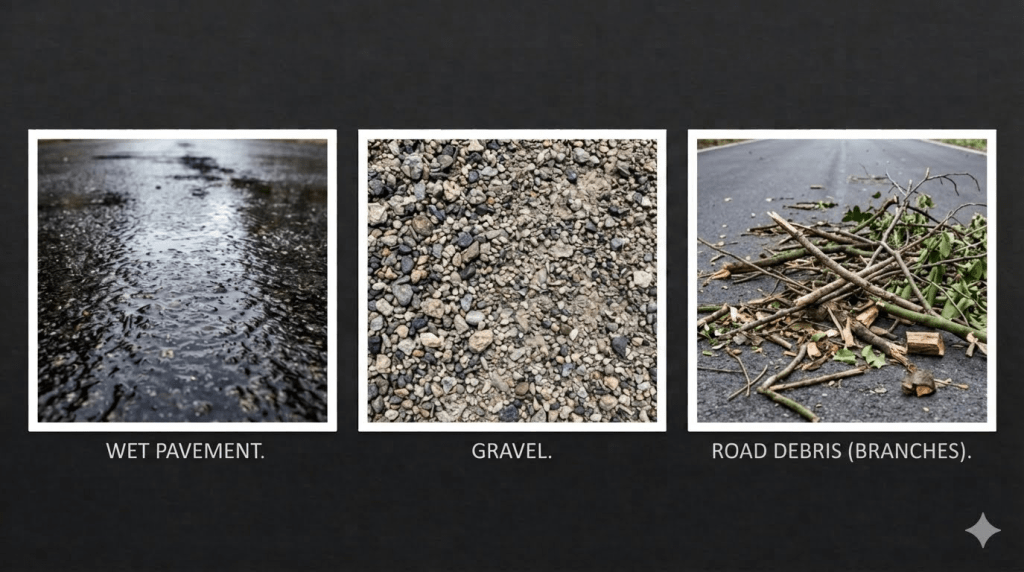
Traction is not a constant, and one of the most dangerous habits a new rider can carry over from driving is assuming the road grips the same everywhere.
- Wet roads cut available traction significantly, especially in the first fifteen minutes of rain, when oil and grime haven’t washed away yet. Braking distances increase, and the margin for a hard grab shrinks fast.
- Gravel and debris can turn a routine stop into a slide in an instant, especially in corners or at intersections where loose material collects.
- Painted lines and metal surfaces — crosswalks, lane markings, steel plates, and manhole covers are deceptively slick, particularly when wet, and often sit right where you’d naturally choose to brake or turn.
Learn to read the road ahead. Not just the hazard in front of you, but the surface you’re about to brake on. This is part of what separates reactive braking from trained, controlled braking. That’s the muscle memory we’ll start building next.
The Right Emergency Braking Technique
Front Brake vs. Rear Brake
On a motorcycle, the front and rear brakes aren’t redundant systems; they’re two different tools. As you brake, weight transfers forward off the rear wheel and onto the front, which means the front tire gains traction and stopping power right when you need it most, while the rear tire loses traction and becomes increasingly easy to lock. This is the opposite of how most new riders instinctively think about it. Many come in believing the rear brake is the “safe” one to lean on, when in a hard stop, it’s actually the one most prone to skidding.
In a full emergency braking scenario, the front brake should be doing the bulk of the work (often 70% or more of your total stopping power) while the rear brake contributes a smaller, steadier amount. Used together and correctly, they cut your stopping distance significantly. Used incorrectly such as grabbing the front or stomping the rear, can put you down.
Progressive Braking: Squeeze, Don’t Grab
The technique that makes front braking safe is progressive application: start with light pressure, then build as the motorcycle’s weight shifts forward and the front tire’s traction increases. Think of it as a rolling squeeze, not a single motion (light, then firm, then maximum, all within a second or two). Grabbing the full amount of pressure instantly, before that weight transfer happens, is what causes the front to wash out. Think of the brake lever not as a switch but as a dial.
Threshold Braking: Maximum Stopping Without Locking Up
Threshold braking is the skill of finding the exact edge of available traction (squeezing as hard as you possibly can without crossing into a skid) and holding right at that line. It’s the difference between a good emergency stop and a great one, and it’s genuinely difficult to learn from description alone, because that threshold changes with road surface, tire condition, and lean angle. This is a feel you build through repetition, which is exactly why the drills later in this article matter more than this paragraph does.
How ABS Changes (and Doesn’t Change) the Equation
ABS doesn’t replace threshold braking; it backstops it. If you’re on an ABS-equipped bike and you brake harder than the available traction allows, the system will rapidly pulse the brake to prevent a full lockup, letting you stop closer to your bike’s true maximum without going down. That’s a real safety net, especially in a genuine panic moment.
What ABS doesn’t do is stop you faster than threshold braking would on a perfect day, and it doesn’t fix bad technique elsewhere (like grabbing too hard, braking mid-corner, or ignoring a bad surface). Think of ABS as insurance for the moments your technique isn’t perfect, not a substitute for building the technique in the first place.
Engine Braking as Part of the Slowdown Sequence
While your hands manage the brakes, downshifting through the gears adds engine braking to the mix. This is the natural deceleration that happens when you roll off the throttle and let compression slow the rear wheel. Working this into your stop, rather than coasting in one gear, does two things: it adds a small amount of controlled, low-drama stopping power, and it leaves you in the correct gear to accelerate immediately if the situation calls for escape instead of a full stop. That sequencing (brake, downshift, brake, downshift) becomes automatic with practice, which is the whole point of this section. As a note, I often get this practice riding to work in traffic.
Evasion: Your First Option, Not Your Last
Why Swerving Is Often Safer Than Braking
Here’s a truth that surprises a lot of new riders: sometimes the safest response to a hazard isn’t stopping at all. It’s not being where the hazard is. A motorcycle can change direction faster than it can stop in a straight line, and in situations with any real reaction-time pressure, a well-executed swerve can put you safely around an obstacle in less distance than braking would’ve taken to stop before it.
This matters because most car-trained instinct treats braking as the only emergency response. On a motorcycle, it’s one of two, and choosing correctly (sometimes braking, sometimes swerving, sometimes a blend of both) is a decision you want to have practiced before you need to make it in half a second.
How to Execute a Proper Swerve
A proper swerve isn’t a wide, gradual lane change. It is a sharp, deliberate press on the handlebar in the direction you want to go (press right to lean right and go right), followed immediately by a press the opposite way to bring the bike back upright and traveling straight again. This is countersteering, and if that sounds counterintuitive, it’s because it is. Pressing the bar in the direction you want to go feels backward the first time you try it. That’s exactly why it needs to be practiced deliberately rather than left to instinct in the moment.
The other key piece: a swerve is two motions, not one. Swerve around the hazard, then swerve back. Riders who only execute the first half end up drifting into the next lane, a ditch, or oncoming traffic. The second correction is not optional.
Identifying Escape Routes Before You Need Them
The Motorcycle Safety Foundation teaches riders to constantly scan for escape routes (the open space you’d move into if the vehicle ahead of you, beside you, or in your path suddenly did something dangerous) before that moment ever arrives. This means actively asking, as you ride: if that car turned left right now, where would I go? If that lane merges into me, is there space to my right?
This isn’t paranoia, it’s a habit of always having an answer ready, so that when a real hazard appears, you’re not searching for options in the same half-second you’re supposed to be reacting.
Practicing Swerve Drills in a Safe Environment
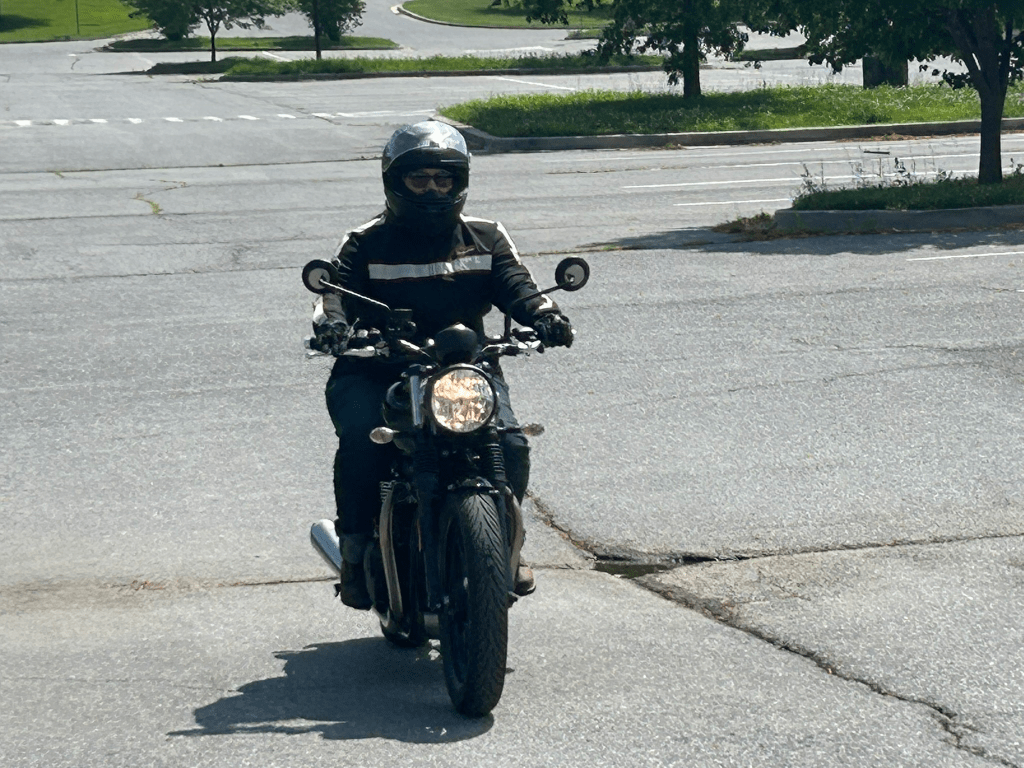
Like braking, swerving is a physical skill, not an intellectual one. Set up cones or any low-stakes markers (I sometimes use the lines already in the parking lot, sticks, leaves, or any object I can visibly see on the ground) in an empty parking lot and practice approaching at a steady speed, then executing a sharp swerve around an obstacle and back into your lane. Start slow, build speed gradually, and pay attention to how much space you actually need to complete both halves of the maneuver. That number is usually smaller than riders expect once the motion becomes automatic, and larger than riders expect the first time they try it under pressure.
Training Your Brain to Override the Car Instinct
Why Muscle Memory Matters More Than Knowing the Theory
Everything covered so far in this article is theory, and theory alone won’t save you. In a genuine emergency, you don’t have time to consciously recall “squeeze progressively, weight transfers forward, threshold is right about here.” Your brain defaults to whatever pathway has been reinforced the most. And if that pathway is still “stomp the brake pedal” from twenty years of driving, that’s what will fire, regardless of what you read this week.
The goal of everything below is to build a new default. One strong enough to compete with, and eventually override, the old one. If you haven’t already, it’s worth reading Part 2 of this series on mastering the friction zone. The same empty-lot, low-speed drills that build slow-speed control are the foundation these emergency-stop drills build on.
Parking Lot Emergency Stop Drills
Find an empty lot and practice this sequence deliberately, at increasing speed as you improve: accelerate to a set speed, pick a fixed point as your “hazard,” and execute a full emergency stop (both brakes, progressive pressure, downshifting) every single time, the same way, until it stops feeling like a sequence of steps and starts feeling like one motion. Log how much distance you need at each speed. That number will drop noticeably over just a few sessions, which is a good, concrete way to see the reprogramming actually happening.
How to Simulate Surprise Stops Safely
The predictable emergency braking drill above builds the mechanics, but real emergencies aren’t predictable so once the fundamentals feel automatic, it helps to introduce an element of surprise. Riding with a trusted friend who calls out “brake now” or “swerve left” at a random, unexpected moment (in a controlled, empty environment) forces you to react rather than anticipate, which is a much closer approximation of what an actual road hazard will feel like.
The Mental Rehearsal Technique: “What Would I Do If…”
Even off the motorcycle, you can keep building the new instinct. As you drive your car, walk your dog, or just sit and think, run scenarios: what would I do if that car pulled out right now? What would I do if that dog bolted? Mentally walk through the correct motorcycle response every time. This kind of visualization is a way to reinforce motor patterns even without physically practicing them, and it’s a free, always-available way to keep reinforcing the override between riding sessions.
Real Scenarios and How to Handle Them
Car pulling out from a side street. This is one of the most common motorcycle hazards, because drivers frequently misjudge a bike’s speed or simply don’t see it. The moment you spot a car at a side street or driveway with any indication it might pull out such as creeping forward, a driver looking the wrong way, or wheels already turning, cover your brakes and identify your escape route immediately, before the car actually moves. If it pulls out, you want emergency braking, a swerve, or both already loaded and ready, not a decision you’re making from scratch. As a note, I also honk my horn to let the driver know I’m there.
Animal in the road. As my own story at the start of this article shows, animals are unpredictable by nature. They don’t signal, they don’t follow traffic logic, and they can change direction in an instant. The car instinct is to brake hard and hope. The motorcycle response is to assess in that first half-second: is there room to swerve around, or is a controlled stop the safer bet? Often, a firm, threshold stop combined with being ready to swerve at the last moment is the right blend. In other words brake hard, but keep an escape route live the whole time.
Sudden stop in traffic ahead. This scenario rewards the “always have an escape route” habit more than any other, because in traffic, your swerve options are often limited by the vehicles around you. Following at a safe distance gives you both more time to threshold brake and more visibility to spot the stop developing before the vehicle directly ahead of you even touches its brakes. Watching two or three cars ahead, not just one, is what buys you that extra second. This is exactly the kind of stop-and-go environment I cover in Mastering Motorcycle Commuting: Tips for New Riders.
(this is also advice you can take with you back to your car driving habits as well).
Debris in your lane. Sudden debris such as a tire fragment, a fallen branch, or a dropped load is often better handled with a swerve than a hard stop, especially at higher speeds, since braking hard directly on top of unknown debris can be its own hazard. This is where the escape-route habit and swerve drills come together: spotting the debris early enough to choose your line calmly, rather than reacting at the last possible moment.
Coming Back to That Morning
Going back to that August morning, seeing the dog on the leash and remembering the moment I hit the brakes the way twenty-some years of driving had trained me to, I realized knowing the “right” answer isn’t the same as being able to produce it under pressure. I could have told you, if you’d quizzed me in a parking lot with no dog in sight, that a hard grab on the front brake alone was risky. It didn’t matter. In the moment, my body reached for the only reflex it had ever built.
That’s the real work of this stage of learning to ride: not reading about threshold braking or swerve technique, but drilling them until they’re the reflex your body reaches for instead. Car instincts got you through decades of safe driving. They will not get you through a motorcycle emergency and the only thing that reliably fixes that gap is repetition, in a parking lot, before you ever need it on the road.
And if you’ve kept with me this long, you should know that in this case, nothing bad happened. The owner of the dog realized she needed to get him out of the street and pulled back on the leash, and at the same time I swerved away from the dog and managed to keep the motorcycle under control and moving forward. But the outcomes are not what dictate the quality of the decision. Sometimes bad decisions have okay outcomes. That doesn’t mean it was a good decision.
If you take one thing from this post, let it be this: find an empty lot this weekend. Practice the emergency braking. Practice the swerve. Do it slowly, then do it faster, then do it when you don’t expect it. The dog on the leash, the car pulling out, or the gravel in the corner isn’t going to wait for you to have read the right article. It’s going to show up, and whatever’s already wired in is what’s going to happen.
Catching up on the series? Start with Part 1: From Four Wheels to Two and Part 2: Mastering the Friction Zone.
Next in this series: Part 4: Scanning the Road Like a Rider, where we’ll cover how trained visual habits and not just reflexes are often what buy you the time to brake or swerve in the first place.
Tell me in the comments: brake or swerve. Which one are you more confident in right now?